What is Backend as a Service: Boost App Speed with Scalable Backends
Understand what is backend as a service and how it helps you launch apps faster with scalable, ready-to-use features.
By Damini
3rd Feb 2026
Last updated: 3rd Feb 2026
Backend as a Service (BaaS) gives you a ready-made, cloud-based backend for your applications, handling everything from databases to user authentication. Think of it like renting a fully-equipped professional kitchen instead of building one from scratch—you get all the essential tools and infrastructure without the setup and maintenance headaches. This frees up your team to focus on what really matters: creating the user-facing features that make your product stand out.
The Foundation of Modern App Development

At its core, BaaS is a model that automates the repetitive, complex, and time-consuming work of server-side development. Every application, from a simple mobile app to a complex internal dashboard, needs a backend to function. This is the "unseen" part of the application, managing all the critical operations that users never directly see but completely rely on.
In the past, development teams would spend countless hours building this infrastructure from the ground up. That meant setting up servers, configuring databases, writing code for user logins, and making sure everything was secure and could handle growth. It was a massive upfront investment of time and resources before any of the unique, customer-facing work could even begin.
Why BaaS Is Gaining Momentum
The big push toward BaaS is all about speed and efficiency. The global BaaS market, valued at USD 3.1 billion in 2022, is on track to hit an incredible USD 28.7 billion by 2032. This explosive growth is a direct response to the demands of a fast-paced, mobile-first world, where getting to market quickly and scaling on demand are everything. You can read more about the market's trajectory and what’s driving this change.
BaaS platforms essentially hide all that backend complexity. Instead of building it yourself, you just connect to pre-built services using APIs (Application Programming Interfaces) and SDKs (Software Development Kits).
By handing off backend management to a specialized provider, teams can dramatically reduce development time, lower operational costs, and get their products to market months ahead of the competition.
This is a game-changer, especially for startups, operations managers, and finance leads who need to build and launch internal tools or MVPs without hiring a dedicated backend engineering team. It lets developers concentrate on polishing the frontend user experience and adding unique business value—which is where your real competitive advantage comes from.
To make this crystal clear, here’s a quick breakdown of what you're really getting with BaaS.
BaaS at a Glance Quick Summary
This table breaks down the core concepts of Backend as a Service for easy understanding.
| Concept | What It Means | Key Takeaway for Your Team |
|---|---|---|
| Pre-built Services | Access to ready-to-use functionalities like authentication, databases, and file storage. | Your team can implement secure user logins and data management in hours, not weeks. |
| Managed Infrastructure | The BaaS provider handles all server maintenance, scaling, and security updates. | No need to hire server admins or worry about downtime; the infrastructure scales automatically. |
| API/SDK Access | Developers connect their frontend application to the backend services via simple interfaces. | Faster integration and less complex code, allowing developers to focus on the user interface. |
In short, BaaS lets you skip the tedious setup and get straight to building the parts of your application that your users (or your internal teams) will actually interact with.
How BaaS Works and Its Core Building Blocks
So, how does this all work in practice? Think of a BaaS platform as a bridge. It connects the part of your application that users actually see and interact with (the frontend) to all the complicated server stuff humming along in the background.
Instead of your developers spending weeks writing code for routine backend jobs, they just tap into these pre-built services using APIs and software development kits (SDKs). It's a lot like building a house with prefabricated walls instead of mixing the concrete and laying every single brick by hand. This completely changes the development game, turning a month-long project into something that can be configured in a few days.
The real magic is that the BaaS provider handles all the messy infrastructure work. They’re on the hook for server maintenance, security updates, and making sure everything scales smoothly when you get a sudden surge of users. Your team gets to step away from the headaches of managing servers.
The Essential BaaS Components
Every BaaS platform is built around a set of core components—the absolute essentials that nearly every application needs. While the exact menu of services can differ from one provider to another, you'll almost always find these key building blocks.
Here’s what a good BaaS brings to the table:
- User Authentication and Management: This handles all your user sign-ups, logins, and password resets securely, right out of the box. Most platforms also support social logins (like Google or Facebook) and single sign-on (SSO), which is a lifesaver for internal tools needing different permission levels for different employees.
- Databases: You get immediate access to a powerful database, whether it's SQL or NoSQL. A key feature here is real-time data synchronization, where any change made on one device instantly updates everywhere else. This is perfect for building collaborative dashboards or live inventory trackers.
- Cloud Storage: Forget the pain of setting up your own storage buckets. BaaS makes it easy to manage user-generated files like photos, PDFs, and videos. It takes care of the uploads, the storage, and even integrates with content delivery networks (CDNs) to make sure files load quickly for users anywhere in the world.
- Push Notifications: A must-have for keeping users in the loop. This is obviously critical for mobile apps, but it's also incredibly useful for internal tools that need to send alerts—like notifying a manager about a new support ticket or a critical system issue.
These pieces don't just exist in a vacuum; they work together to create a solid backend. Imagine an internal dashboard for your operations team. It could use BaaS authentication to control who sees what, a real-time database to show live shipping data, and push notifications to alert the team when a delivery is delayed.
By bundling these core services into a ready-to-use package, BaaS lets teams snap together a powerful backend without writing a single line of server code. This frees them up to focus on what actually matters: building a great experience for their users.
The Real-World Benefits of Using BaaS
It's one thing to understand the technical "what" of BaaS, but the real magic is in the business outcomes it creates. For anyone on a product team, the advantages aren't just theoretical—they show up on the bottom line. This isn't just about writing less code; it’s about fundamentally changing how fast you can bring an idea to life.
For founders and developers, the most immediate win is speed. Think about it: instead of spending months building out the basic backend plumbing for a new product, you can have a working version up and running in a fraction of the time. This isn't just a convenience; it's a massive competitive advantage that lets you launch, get feedback, and iterate while others are still architecting their databases.
Product managers get a huge boost, too. BaaS makes rapid prototyping a reality. You can spin up a minimum viable product (MVP) to test a new concept without sinking a ton of time and money into backend infrastructure. This agility lets you validate what the market actually wants and pivot quickly, ensuring you're always building features that matter.
Unlocking Cost Savings and Operational Efficiency
When you talk to the ops and finance folks, the conversation quickly turns to the numbers, and the financial case for BaaS is incredibly strong. Adopting a BaaS model often means you can delay or even avoid hiring specialized backend engineers, which is a major payroll expense. On top of that, all the costs tied to buying, managing, and maintaining your own server infrastructure simply vanish.
By handing off the backend, companies can shift money away from infrastructure overhead and pour it directly into what grows the business—marketing, sales, and product innovation. You’re essentially swapping unpredictable capital expenses (CapEx) for a clear, manageable operational expense (OpEx).
This shift is fueling some pretty staggering market growth. The BaaS market is expected to rocket from USD 11.83 billion in 2024 to an incredible USD 658.7 billion by 2032. That explosion is being driven by an insatiable demand for faster, cheaper ways to build software, especially in fields like IT and healthcare. You can read more about the BaaS market's incredible growth trajectory to see just how big this trend is.
Key Advantages Across the Team
The benefits ripple out to everyone, creating a team that’s more aligned and effective. Here’s how it breaks down for different roles:
- Faster Time-to-Market: You can launch apps and internal tools months ahead of schedule, giving you a serious head start on the competition.
- Reduced Development Costs: Sidestep the high price of a large backend team and the endless cycle of server procurement and maintenance.
- Built-in Scalability: When you get a sudden spike in traffic, the platform handles it automatically. Your app stays fast and stable as you grow, without anyone having to scramble.
- Enhanced Focus: Your developers get to spend their brainpower on the unique, user-facing features that actually differentiate your product, not on reinventing the wheel with backend chores.
Ultimately, using BaaS allows the entire team—from the developer writing the code to the finance lead approving the budget—to rally around one simple goal: shipping a great product to users as quickly and efficiently as possible.
4. BaaS vs. PaaS vs. FaaS vs. Custom Backends
Choosing the right way to build your application's backend isn't just a technical decision; it's a strategic one. It directly impacts your launch timeline, budget, and long-term maintenance burden. The choice isn't just "build" or "buy"—you've got a whole spectrum of options, including Platform as a Service (PaaS), Function as a Service (FaaS), and the classic custom-built backend.
Let's break down how they all stack up.
The Spectrum of Control and Convenience
Think of these options as a ladder of abstraction. At the bottom, you have the most control but also the most work. As you climb up, you trade some of that granular control for pre-built components and managed infrastructure, letting you move much, much faster.
-
Custom Backend (The Ground Floor): This is where you build everything from the ground up. You hand-pick the programming language, design the database schema, configure the servers—you control every single detail. This gives you ultimate flexibility for highly specialized applications, but it's also the most time-consuming and expensive path. It demands a dedicated engineering team just to build and maintain it.
-
PaaS (Platform as a Service): Moving one step up the ladder, PaaS providers like Heroku or AWS Elastic Beanstalk handle the underlying infrastructure for you. They manage the servers, operating systems, and networking. You're still responsible for writing all the backend code and logic for your application, but you don't have to worry about the hardware it runs on. It's like renting a fully equipped workshop—all the heavy machinery is there, but you still have to design and build the product yourself.
-
FaaS (Function as a Service): Often called "serverless," FaaS takes abstraction even further. With services like AWS Lambda or Google Cloud Functions, you only write small, isolated pieces of code (functions) that run in response to specific triggers. The platform handles everything else. This is fantastic for event-driven tasks like processing an image upload, but orchestrating many functions to create a full-fledged application can get complicated quickly.
-
BaaS (Backend as a Service): At the top of the ladder, BaaS is the most managed solution. It provides not just the infrastructure but also a suite of pre-built, ready-to-use backend services like user authentication, databases, and file storage, all accessible via APIs. This is the "fully-furnished apartment" approach. You can move in and start living (or in this case, building your frontend) on day one without worrying about the plumbing or electricity.
This decision tree gives you a quick visual guide for thinking through which path makes the most sense for your project's goals.
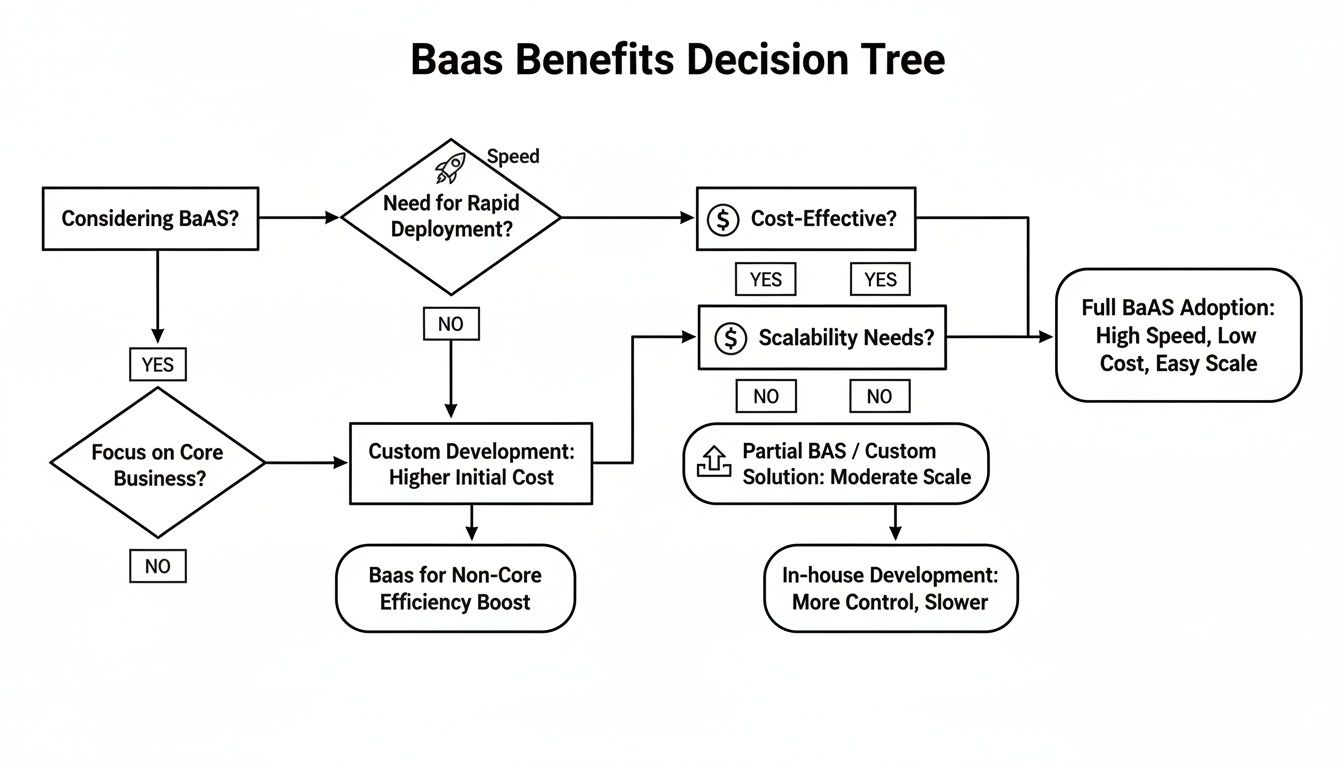
The big takeaway? BaaS is designed to give you the fastest path from idea to a working product by handling all the repetitive, non-differentiating backend work for you.
A Head-to-Head Comparison
To make the choice clearer, let's put these models side-by-side and see how they compare across the criteria that matter most to teams.
Backend Development Models Compared
| Criteria | BaaS (Backend as a Service) | PaaS (Platform as a Service) | FaaS (Function as a Service) | Custom Backend |
|---|---|---|---|---|
| Speed to Market | Fastest. Pre-built components dramatically cut development time. Ideal for MVPs and internal tools. | Moderate. Faster than a custom build, but you still need to write all backend application code. | Fast for individual tasks. Can be complex to assemble into a full application, potentially slowing overall delivery. | Slowest. Everything is built from scratch, requiring extensive development, testing, and deployment cycles. |
| Development Cost | Low. Minimal backend developers needed. Pay-as-you-go pricing is common. | Medium. Reduces infrastructure costs, but still requires significant backend development investment. | Low to Medium. Pay-per-execution can be very cost-effective, but costs can become unpredictable at high scale. | High. Requires a full team of backend engineers, DevOps, and ongoing maintenance salaries. |
| Control & Flexibility | Moderate. You have control over the frontend and business logic, but backend components are standardized. | High. Full control over the application code and architecture, with less control over the underlying infrastructure. | Low. You only control the individual function's code, not the surrounding environment or execution context. | Total. Absolute control over every single component, from the hardware to the code. |
| Scalability | High. Built-in, automatic scaling managed by the provider is a core feature. | Moderate to High. Most PaaS solutions offer auto-scaling features, but they may require configuration. | Extremely High. Scales automatically and instantly based on demand, from zero to millions of requests. | Manual. Requires a dedicated DevOps or SRE team to design, implement, and manage a scaling strategy. |
| Best For | Internal tools, dashboards, mobile apps, MVPs, and projects where speed is the top priority. | Web applications with custom backend logic that don't want to manage servers. | Event-driven microservices, data processing pipelines, and isolated, on-demand tasks. | Highly specialized, performance-critical systems, or applications with unique compliance and security needs. |
Ultimately, the model you choose is a direct reflection of your project's priorities.
If you're a founder trying to get a Minimum Viable Product (MVP) to market before the competition, or an ops manager who needs a reliable internal dashboard this quarter, BaaS is almost always the right answer. It prioritizes speed and efficiency above all else.
On the other hand, if you're building a high-frequency trading platform where every nanosecond counts, the absolute control of a custom backend is non-negotiable. The trade-off is clear: you sacrifice speed and budget for total, granular control.
Practical Use Cases for Backend as a Service
Theory is one thing, but the real magic of BaaS happens when you see what it can do in the real world. It's not just for flashy consumer apps; it's a workhorse for building the exact internal tools that growing companies desperately need but often can't find the resources to create from scratch.
Think about an operations team drowning in spreadsheets to manage logistics. With BaaS, a developer—or even a technically-inclined ops manager using a modern low-code tool—can quickly spin up a real-time logistics dashboard. They can use the pre-built BaaS pieces to pull in data from shipping APIs, show everything on a live map, and even trigger automated alerts when a package is delayed.
This same logic applies everywhere in a business. A sales team could get a custom CRM built just for their unique process. A finance lead could finally have a reporting tool that pulls data from three different systems into one clean, simple view. All of this can be done without touching a line of server code, turning what used to be a six-month headache into a weekend project.
Building for Internal and External Audiences
While internal tools are a huge win, BaaS is equally powerful for building customer-facing applications. Its flexibility makes it a great starting point for all sorts of projects that need to get off the ground quickly and handle real-world traffic.
Here are a few classic examples:
- Minimum Viable Products (MVPs): For any startup, speed is everything. BaaS lets founders launch an MVP in weeks instead of months, letting them test an idea with actual users before sinking a huge amount of time and money into engineering.
- Mobile Applications: BaaS comes with all the standard stuff a mobile app needs right out of the box—user sign-ins, a place to store data, and the push notifications required to keep people coming back.
- Customer-Facing Web Platforms: Whether you’re building a small e-commerce site or a secure client portal, BaaS can manage the user accounts, data, and file storage needed to create a professional experience.
The core idea is simple: BaaS gives you the standard, pre-built backend parts so your team can stop reinventing the wheel and focus their energy on building the unique features that actually matter to your users, whether they're employees or customers.
This ability to build and ship quickly is why the BaaS market is exploding. It's expected to jump from USD 27.56 billion in 2024 to an incredible USD 114.05 billion by 2035. As more businesses move to the cloud, BaaS is becoming the go-to choice for teams that value speed and efficiency above all else. You can read more about the BaaS market's rapid expansion and what's driving it.
How to Choose the Right BaaS Provider
Picking the right Backend as a Service provider isn't just a technical choice—it's a business decision that will echo through your development cycles and impact your ability to grow. It’s easy to get dazzled by a long list of features, but the real trick is to zero in on what truly matters for your project, your team, and your long-term goals.
Let's start with the money. Most providers will tempt you with a generous free tier, which is great for getting started. But you need to look past that and figure out what happens when you succeed. Dig into their pricing models. Is it a clear, pay-as-you-go system, or are there hidden costs lurking in the fine print? Don't be shy about asking about overage fees for API calls or traffic spikes. You want predictable costs, not a surprise bill when you hit a new growth spurt.
Evaluating Technical and Strategic Fit
Next up is performance. Your backend needs to be able to handle a sudden rush of users without breaking a sweat. A provider with a solid global infrastructure, including a content delivery network (CDN), is a must-have for delivering a snappy experience to users, whether they're next door or on the other side of the world.
And then there's the big one: security and compliance. This is where you can't afford to cut corners.
- Check the Certs: Look for providers that meet well-known security standards like SOC 2 or ISO 27001. This shows they take security seriously.
- Know the Rules: If your app handles sensitive information, you need to make sure the BaaS complies with regulations like GDPR or HIPAA.
- Read the Manual: A trustworthy provider will have their security and data protection policies laid out in clear, easy-to-find documentation.
Finally, think about the future and the risk of vendor lock-in. You don't want to build your entire application on a platform, only to realize years later that it's nearly impossible to leave. It's like building a house on rented land.
A smart move is to choose a BaaS provider that lets you easily export your data and works with standard technologies. This gives you the freedom to pivot or migrate later without a massive headache.
Opting for platforms that let you write custom logic in common languages like JavaScript or Python also helps. By weighing these factors, you’ll find a partner that not only helps you build faster today but also grows with you tomorrow.
Still Have Questions About BaaS?
Even after getting the rundown on Backend as a Service, a few key questions always seem to pop up when teams are on the fence about using it. Let's tackle some of the most common ones so you can feel confident about your decision.
Is BaaS Secure Enough for Serious Business?
This is a big one, and the short answer is yes—if you pick the right provider. Reputable BaaS platforms sink huge amounts of money and expertise into security, often far more than a single company could justify.
They're constantly hardening their infrastructure, managing encryption, and undergoing rigorous security audits. Many also offer enterprise-level features like granular role-based access control and are certified for standards like SOC 2, GDPR, and HIPAA. For most businesses, this makes them a very secure bet.
What's the Catch? Where Does BaaS Fall Short?
The main trade-off is giving up some control. Because someone else is managing the servers and core logic, you can't just SSH in and tweak the low-level server configuration or radically overhaul the database architecture.
This can be a real blocker for applications with truly unique performance demands. But for the vast majority of projects—especially internal tools, dashboards, and mobile apps—the incredible speed you gain is more than worth it.
The biggest risk to watch out for is vendor lock-in. Once you build on a platform, moving your entire backend to another provider can be a massive, painful undertaking.
To keep your options open, look for providers that make it easy to export your data and build on common, open-source technologies. This gives you an exit strategy and ensures you’re not stuck if your needs change down the road.
Ready to build internal tools and dashboards in minutes, not months? With FlyDash, you can describe what you need, and our AI will generate a complete, working application with a frontend, backend, and database. No code required. Build faster and collaborate in real-time by visiting https://flydash.io.
Ready to Build Your App?
Turn your idea into a production-ready React Native app in minutes.
Free tools to get you started
Free AI PRD Generator
Generate a professional product requirements document in seconds. Describe your product idea and get a complete, structured PRD instantly.
Try it freeFree AI App Name Generator
Generate unique, brandable app name ideas with AI. Get creative name suggestions with taglines, brand colors, and monogram previews.
Try it freeFree AI App Icon Generator
Generate beautiful, professional app icons with AI. Describe your app and get multiple icon variations in different styles, ready for App Store and Google Play.
Try it freeFrequently Asked Questions
RapidNative is an AI-powered mobile app builder. Describe the app you want in plain English and RapidNative generates real, production-ready React Native screens you can preview, edit, and publish to the App Store or Google Play.