What Is Rapid Application Development A Guide to Building Better Software Faster
Discover what is rapid application development (RAD). This guide explains the RAD methodology, its phases, and how it accelerates software creation.
By Damini
15th Jan 2026
Last updated: 16th Jan 2026
Picture this: you spend a year building a house based on a detailed blueprint, only to discover the family's needs have completely changed by the time you're done. That's the old way of building software. Rapid Application Development (RAD) throws that outdated blueprint out the window. It’s an approach built for speed, embracing change and putting user feedback at the center of everything.
Unpacking the Rapid Application Development Model
At its heart, Rapid Application Development is less of a rigid methodology and more of a mindset. It's all about getting a working product into the hands of users as fast as humanly possible. Instead of getting stuck in months of detailed planning and writing massive specification documents, RAD teams jump straight into building interactive prototypes.
Think of it like sculpting with clay versus carving stone. When you're carving stone—much like the traditional Waterfall method—every move is final. Mistakes are costly, and changing your mind halfway through is practically impossible. But with clay, you can mold a basic shape, show it to someone, get their thoughts, and immediately start refining it. You can add a bit here, smooth an edge there, and constantly evolve the design.
That's exactly what RAD does for software. It makes the development process a dynamic conversation, ensuring the final product actually solves a real problem because the people who will use it help build it from day one.
Core Principles Driving RAD
The RAD model stands on a few simple but powerful ideas that set it apart. These principles are all geared toward one goal: delivering real value, fast, while minimizing the risk of building the wrong thing.
To get a clearer picture, let's break down the core philosophy of RAD.
| Rapid Application Development At a Glance | | :--- | :--- | | Core Principle | What It Means in Practice | | Prototyping Over Planning | Forget hundred-page spec docs. Instead, build a clickable, testable model that users can actually interact with. | | Active User Involvement | Users aren't just an afterthought. They are partners in the process, providing feedback from the first prototype to the final release. | | Iterative, Time-Boxed Cycles | The project is broken into small, manageable chunks, each built within a fixed, short timeframe (a "time-box"). | | Flexibility and Adaptability | A new idea or a change in requirements isn't a crisis. It's just another iteration. The model is built to welcome change. |
These principles work together to create a development cycle that is both fast and responsive.
The core idea of RAD is simple: people are building software, not a bridge. Software has the flexibility to evolve, and the development process should reflect that. It should be a product that closely mirrors the dynamic needs of its end-users.
This practical, results-oriented approach makes RAD a favorite for startup founders and operations managers—anyone who needs to get a solution to market quickly and be ready to adapt to whatever comes next.
The Story Behind Building Software Faster
To really get why Rapid Application Development even exists, we have to rewind to the 1980s. Back then, the software industry was stuck in what many called the "software crisis." Building anything was slow, wildly expensive, and rigid, all thanks to one dominant method: the Waterfall model.
Think of building a house where the blueprint is locked in stone before a single nail is hammered. You have to finish the entire foundation before you can even think about plumbing, and you can't touch the drywall until every single wire is in place. That's Waterfall in a nutshell—a strict, top-to-bottom process where you couldn't move to the next step until the previous one was 100% complete and signed off.
This step-by-step approach was a recipe for disaster. Projects would burn months, sometimes years, just in the initial planning and requirements phase. By the time the developers finally delivered something, the business needs had often completely changed. The final product was usually late, way over budget, and, worst of all, already outdated the day it launched.
The Breaking Point for Traditional Methods
This inflexibility led to a staggering number of failed projects. The chasm between what users actually needed and what developers were building just kept getting wider as projects dragged on. It was clear that a new way of thinking was desperately needed—one that could actually keep up with the real world.
It was in this environment of frustration that new ideas started to take root. A few forward-thinkers began to challenge the core belief that software had to be built like a bridge, with a long, drawn-out, unchangeable plan. They argued that software is fundamentally different; it's malleable and should be built in a way that welcomes change, not resists it.
This new mindset was championed by people like Barry Boehm and later codified by James Martin. In his 1991 book, Martin officially defined Rapid Application Development (RAD) right when businesses were scrambling to go digital. This was perfect timing, as the Waterfall model, which had been around since the 1970s, was failing on a massive scale. In fact, some studies showed that up to 70% of large IT projects using Waterfall blew past their budgets by 189% and their timelines by 222%, often ending up with a product nobody could use. You can dive deeper into the history of RAD and agile methodologies to learn more.
A New Philosophy Emerges
RAD wasn't just a new set of steps; it was a total philosophical shift. It tossed out exhaustive, long-winded documentation in favor of working prototypes. It broke down the walls between development phases and brought in constant collaboration with the people who would actually use the software.
The core ideas it introduced were revolutionary at the time:
- Iterative Development: Instead of one massive, all-or-nothing build, software was built in small, manageable cycles.
- Active User Involvement: Users were pulled into the process from day one. They weren't just waiting at the finish line; they were active partners, giving feedback on early models.
- Emphasis on Prototyping: The focus moved from writing dense requirement documents to creating tangible, clickable prototypes that users could get their hands on.
RAD was born from a simple but powerful realization: Building software should be a conversation, not a monologue. Its goal was to close the gap between creators and users, ensuring that what gets built is what is actually needed.
Understanding this history is key because it shows RAD wasn't just some academic theory. It was a practical, real-world solution to a massive industry-wide problem. It set the stage for many of the agile and iterative methods we take for an granted today, including the principles that drive modern tools like the AI-powered app builder from FlyDash.
The Four Essential Phases of a RAD Project
Unlike the slow, methodical march of traditional software development, a RAD project is more like a focused, iterative sprint. The entire lifecycle is built around four distinct phases, each designed to get a working product into users' hands as quickly as possible while gathering constant feedback. This structure prevents great ideas from getting bogged down in endless documentation or outdated plans.
This diagram shows how we got here, tracing the evolution from the rigid, one-way street of the Waterfall model to the flexible, cyclical nature of Rapid Application Development.
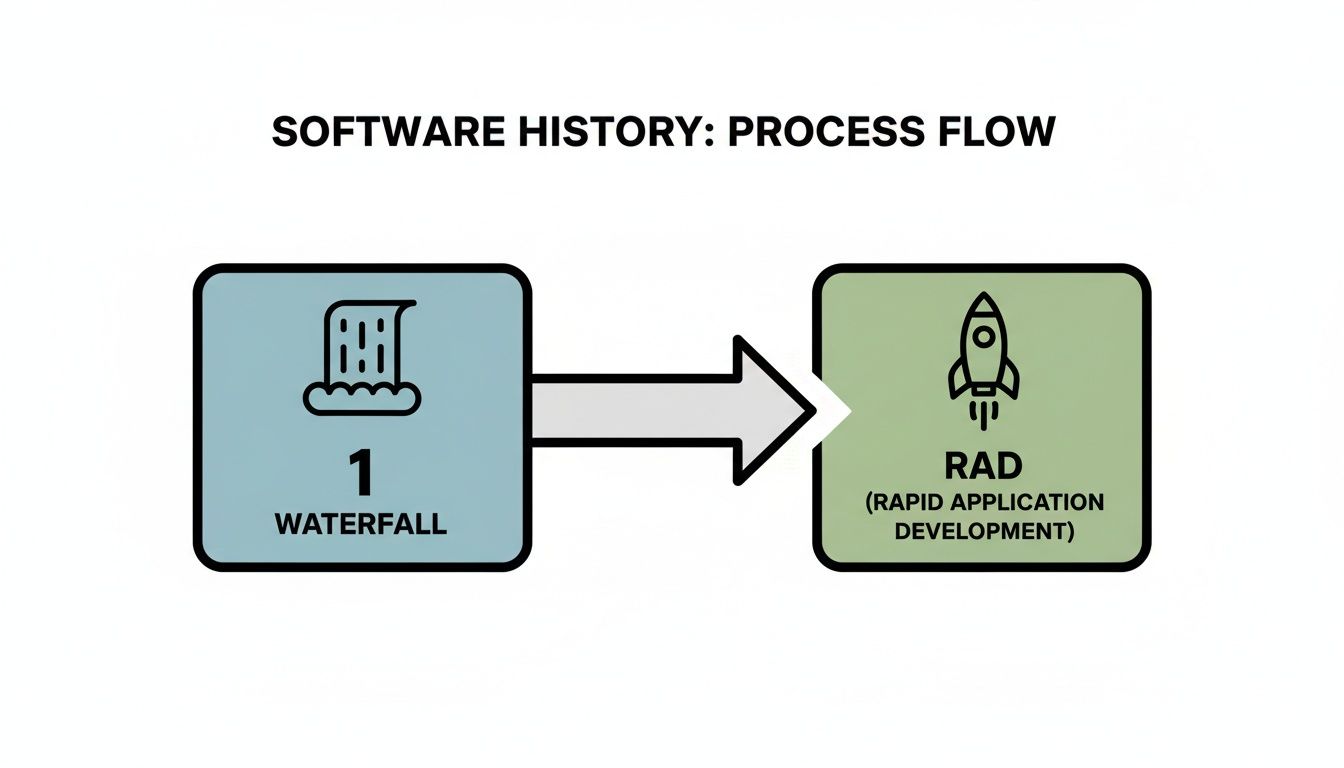
You can see the fundamental shift in philosophy—moving from a linear path to a user-centric model that’s all about speed and adaptation. Let's break down the four phases that make this happen.
Phase 1: Requirements Planning
The first phase, Requirements Planning, is a highly collaborative kickoff workshop. Forget the old days where developers would take a thick requirements document and disappear for months. Here, they get in a room with users, stakeholders, and managers to hash things out. The goal isn't to nail down every last detail; it's to agree on the project's broad scope and critical business needs.
This is all about speed and alignment. Discussions stay at a high level, focusing on the "what" and "why" instead of getting lost in the "how." The result is a lightweight, flexible project outline—just enough to get started without creating a rigid plan that will be obsolete in a few weeks.
Phase 2: User Design
This is where the real magic of RAD comes to life. During the User Design phase, developers and users work side-by-side in a continuous feedback loop to build and refine prototypes. These aren't just static mockups; they are interactive, clickable models of the application that users can actually get their hands on.
This hands-on approach delivers immediate, practical feedback. A user might click a button and say, "Wait, this isn't what I expected," or, "It would be much better if this dashboard showed real-time data." Developers can often make those changes on the spot.
This cycle of prototyping, testing, and refining is the engine of Rapid Application Development. It ensures that the final product is shaped by the people who will actually use it, dramatically reducing the risk of building something that misses the mark.
This back-and-forth continues until the user design is approved and everyone agrees the prototype solves their problem effectively.
Phase 3: Construction
With a user-approved prototype locked in, the Construction phase becomes incredibly efficient. This is where the prototype gets turned into a real, working application. Because the tough UI and functionality decisions have already been made, developers can focus purely on building clean, high-quality code.
The main activities in this phase are pretty straightforward:
- Finalizing Code: Developers write the production-ready code for the application.
- Integrating Components: All the different pieces of the software are connected and tested together.
- Unit and System Testing: The team runs rigorous tests to make sure everything is stable and bug-free.
Modern low-code and no-code platforms have put this phase on steroids. These tools can often automate huge chunks of the coding, allowing teams to generate a functional application directly from the prototype with very little manual effort. It’s a massive accelerator.
Phase 4: Cutover
The final phase, Cutover, is all about deploying the finished product into the live environment. This is way more than just flipping a switch; it's a carefully managed transition to guarantee a smooth launch for everyone.
Key steps during the cutover phase include:
- Final Data Conversion: Moving any necessary data from old systems into the new application.
- Intensive Testing: Running one last round of full-scale testing in an environment that mirrors production.
- User Training: Making sure every end-user is trained and comfortable with the new system.
- Deployment: Rolling out the application, which could happen all at once or in stages.
Even after launch, the RAD mindset continues. User feedback is still collected, setting the stage for future updates and improvements. This ensures the application keeps evolving with the business's needs, delivering value long after its initial release.
How RAD Compares to Waterfall and Agile
To really get a feel for what makes Rapid Application Development tick, it helps to see how it stacks up against the other big names in software development. RAD didn't just appear out of nowhere; it was a direct answer to the rigid, step-by-step process of the Waterfall model and it shares a lot of DNA with the broader Agile movement.
Figuring out these differences is the key to knowing when RAD is the right tool for the job. Each approach has its own rhythm and is best suited for certain types of projects—kind of like choosing whether you need to build a skyscraper, a custom-designed house, or a pre-fabricated tiny home.
The Waterfall Model: The Assembly Line
Think of the Waterfall model as the old-school, traditional way of building software. It’s the granddaddy of all modern methodologies. Imagine building a car on a classic assembly line: you have to complete the chassis before you can add the engine, and the engine has to be installed before you can attach the body panels. Each phase flows neatly—and irreversibly—into the next.
There’s no turning back. A decision made during the requirements phase is basically set in stone. This rigid structure demands a massive amount of planning and documentation upfront because making a change late in the game is an absolute nightmare—incredibly expensive and disruptive.
RAD is the polar opposite. It completely throws out this one-way street approach for something far more flexible. If Waterfall is an assembly line, think of RAD as a sculptor's workshop, where the clay is constantly being shaped and refined based on what the artist sees and feels in the moment.
The Agile Philosophy: The Sports Team
Agile isn't a single methodology so much as a guiding philosophy that includes a bunch of different frameworks, like Scrum and Kanban. The big idea behind Agile is to prioritize iterative development, close team collaboration, and being able to respond to change rather than just blindly following a plan. If Waterfall is that assembly line, Agile is more like a rugby team, constantly passing the ball and adapting its strategy on the fly to move down the field together.
So where does RAD fit in? It’s very much part of the Agile family. Both RAD and other Agile methods are built on the same core values:
- Iterative Cycles: Both break down massive projects into smaller, more manageable pieces.
- Customer Collaboration: Both depend on getting constant feedback from the people who will actually use the software.
- Adaptability: Both not only accept but welcome changing requirements as a normal part of the process.
The main difference really comes down to focus. While Agile provides a broad set of principles for managing iterative work, RAD is a specific way of doing it with a laser focus on rapid prototyping and user interface design. RAD’s signature move is using working models to drive the entire project forward, often sped up by specialized tools.
RAD can be seen as a highly specialized form of Agile, one that is hyper-focused on speed and prototyping. While all RAD is Agile, not all Agile is RAD.
This subtle difference becomes a lot clearer when you look at the day-to-day work. An Agile Scrum team might spend a two-week sprint building and testing a small, shippable piece of a feature. In that same timeframe, a RAD team might build and refine three different interactive prototypes directly with users until the design is absolutely perfect. Only then would they use a low-code tool to build the final feature, often in a fraction of the time. You can get more insights on these nuances in a deep dive on Waterfall, Agile, and RAD models.
A Head-to-Head Comparison
To make the distinctions crystal clear, here’s a quick rundown of how these three approaches stack up against each other. This table highlights their fundamental differences.
| RAD vs Waterfall vs Agile A Quick Comparison | | :--- | :--- | :--- | :--- | | Attribute | Waterfall | Agile | Rapid Application Development (RAD) | | Flexibility | Very Low. Changes are difficult and expensive to implement once a phase is complete. | High. Changes are welcomed between cycles, and the plan is expected to evolve. | Very High. Built entirely around adapting to user feedback from interactive prototypes. | | User Involvement | Minimal. Users are typically involved only at the beginning (requirements) and the end (acceptance testing). | Continuous. Users and stakeholders are actively involved throughout the project, often daily. | Intense. Users are co-designers, directly interacting with and shaping prototypes from day one. | | Speed | Slow. Long planning phases and a sequential process result in lengthy delivery timelines. | Fast. Delivers working software in small, regular increments (sprints). | Fastest. Focuses on delivering a functional application in the shortest possible time, often in weeks. | | Prototyping | None. The final product is the first version the user interacts with. | Optional. Prototyping may be used, but the focus is on delivering shippable code. | Mandatory. The entire process is driven by building, testing, and refining working prototypes. |
In the end, choosing the right methodology comes down to the project itself. For a mission-critical system where the requirements are fixed and cannot change, Waterfall’s rigid structure offers stability. For complex projects that need continuous team collaboration and incremental progress, Agile is a fantastic fit. But when the user experience is everything and getting to market fast is the number one priority, what is Rapid Application Development offers an advantage that’s hard to beat.
The Real Pros and Cons of RAD
Look, no development methodology is a silver bullet. Before you jump on the Rapid Application Development bandwagon, you need a clear-eyed view of what you're getting into. The upsides are huge, often hitting business goals with incredible speed. But that same fast, flexible nature comes with its own set of challenges your team needs to be ready for.
Getting this balance right is the key to deciding if RAD is the smart move for your project or if you’d be better off with a different playbook.
Why Teams Love RAD: The Big Wins
The number one reason people turn to RAD is simple: speed. It's a total game-changer for businesses that need to get a product or an internal tool out the door yesterday. You get to skip the endless planning and documentation cycles of older methods and deliver working software in a fraction of the time. Think about what that means for a startup—launching an MVP in weeks, not months.
This speed creates a ripple effect, leading to other powerful advantages:
- Better End Products: When real users are giving feedback from the very first prototype, the final app is almost guaranteed to hit the mark. You're catching bugs and fixing clunky workflows early on, not after a disastrous launch.
- Adaptability is Baked In: RAD is built for change. If market needs shift or a new business opportunity pops up mid-project, the team can pivot without throwing everything into chaos. It expects the unexpected.
- Lower Project Risk: Building and testing in small, quick cycles massively reduces the risk of a catastrophic failure. You find out if an idea has legs long before you’ve poured a huge budget and countless hours into it.
By focusing on working software and constant user feedback, RAD doesn't just speed up delivery—it makes sure you're building what people actually want and need.
The Potential Pitfalls and Hurdles
Of course, this fast-and-loose approach has its downsides. RAD is demanding, and it puts a lot of pressure on everyone involved. The single biggest requirement is high user involvement. If your end-users are too busy or just aren't interested in providing regular feedback, the whole process grinds to a halt. The feedback loop is the engine of RAD; without it, you're dead in the water.
You might also run into trouble in a few other areas:
- Not Ideal for massive Projects: For huge, enterprise-wide systems with a spiderweb of backend complexities and integrations, RAD’s light-on-its-feet planning can become a liability. It shines brightest on projects with a well-defined, modular scope.
- Needs an A-Team: This model thrives with a small crew of senior developers. You need people who are skilled, work well together, and aren’t afraid of a little ambiguity. Junior developers often need more structure and detailed documentation to succeed.
- The Danger of "Scope Creep": The constant feedback is great, but it can easily lead to an endless stream of new feature requests. Without a strong project manager to keep everyone focused, the project can balloon far beyond its original purpose.
The proof is in the numbers. RAD has been shown to cut development timelines by up to 70% compared to Waterfall, all while producing higher-quality software thanks to that relentless user feedback. This agility is crucial, especially when you consider that 65% of requirements change after a project starts. You can dig into more stats on how RAD accelerates development cycles on monday.com.
Ultimately, making RAD work comes down to having the right team, committed users, and a project that truly fits its fast, iterative rhythm.
How Modern Tools Power the RAD Revolution
The core ideas behind Rapid Application Development were honestly a bit ahead of their time. The vision was there, but the technology just wasn't. Today, that's completely changed. A new generation of powerful tools has finally caught up, acting as the engine for a modern RAD revolution and making its principles of speed and iteration a practical reality for just about everyone.
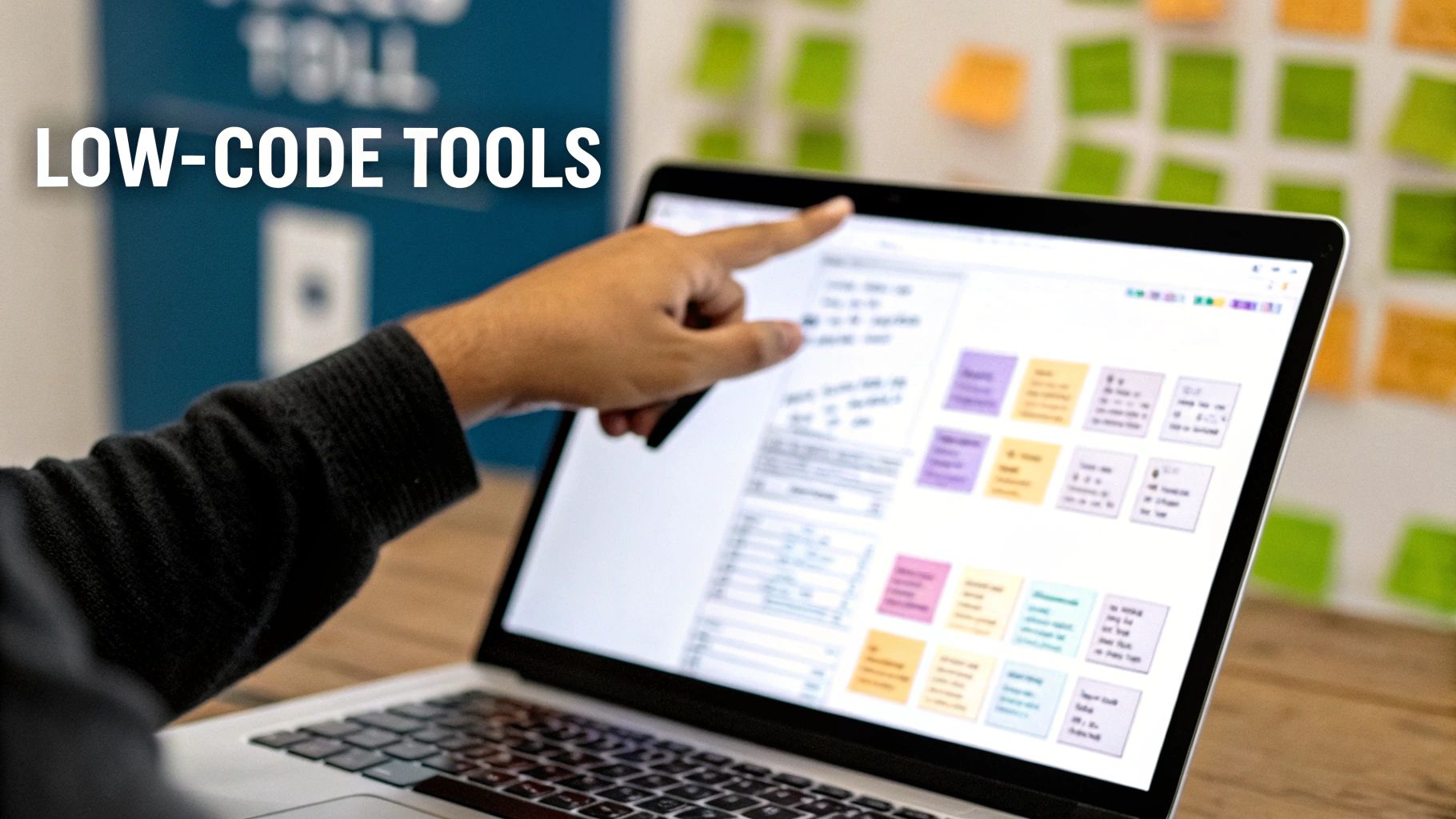
This screenshot gives you a glimpse into a low-code platform. Instead of writing lines of code, the user is building an application with visual, drag-and-drop components. It’s tools like these that are unlocking the true potential of RAD by making development accessible and incredibly fast.
The Rise of Low-Code and No-Code Platforms
At the heart of this shift are low-code and no-code platforms. Think of them as sophisticated software-building toolkits. Instead of expecting developers to code everything from scratch, these platforms offer pre-built visual components—like buttons, forms, and charts—that you can assemble into a fully functional application.
This approach puts every phase of the RAD cycle into hyperdrive. Something that might have taken weeks of coding can now be prototyped in a single afternoon. An operations manager, for instance, could drag and drop a few elements together to create a working model of an inventory dashboard and get immediate feedback from the warehouse staff.
This shift really democratizes software development. It gives power to the business experts who understand the problems best—like finance leads or product managers—letting them build the solutions they need without getting stuck in a long IT queue.
And the numbers back this up. The market for these tools was valued at $49.8 billion USD in 2022 and is expected to explode to $802.8 billion by 2030. It’s no surprise that 75% of enterprises plan to use these platforms by 2025 to fill talent gaps and ship products faster. You can dig into the full market analysis on Quixy.com.
From Prototype to Production in Record Time
Modern RAD tools aren't just for building pretty mockups; they create real, production-ready applications. Many platforms, like the AI-powered builder from FlyDash, can automatically generate the frontend, backend, and database for an entire application from a simple text description. This changes the game completely.
Here’s what these modern tools bring to the table:
- Visual Development: Building user interfaces feels more like designing a slide than writing code.
- Built-in Connectors: They can seamlessly link up with existing databases, REST APIs, and other services without a bunch of complex integration work.
- One-Click Deployment: You can launch and update applications without needing a whole DevOps team to manage the pipeline.
- Real-Time Collaboration: Multiple people can build and edit an application at the same time, a lot like working together in a Google Doc.
Ultimately, these tools are delivering on the original promise of RAD: building high-quality software at the speed of business. By empowering more people to build and providing the technical horsepower to do it quickly, they’ve turned a once-niche methodology into a mainstream strategy for staying nimble.
Frequently Asked Questions About RAD
Even after you've got a handle on the theory, a few practical questions always pop up when a team thinks about switching to a new methodology. Let's clear up some of the most common ones to help you figure out if RAD is the right move for your next project.
Getting these details straight can give you the confidence to really run with RAD's core principles.
What Kind of Projects Are Best for Rapid Application Development?
RAD is in its element on projects where the user interface is make-or-break and you know the requirements are going to change along the way. Think internal business tools, customer dashboards, and Minimum Viable Products (MVPs). For these, getting a working product in front of users and iterating based on their feedback is everything.
On the flip side, it’s not the best choice for projects that are all about complex, "headless" backend logic with little to no user interface. It also tends to be a poor fit for systems locked into strict, pre-defined regulatory rules where any deviation from the plan is a problem, not a feature.
Is RAD Just Another Name for Prototyping?
Not quite. While prototyping is the engine that drives RAD, it's just one piece of a much bigger machine.
It helps to think of it like this: prototyping is a specific activity, like sketching a blueprint. Rapid Application Development is the entire construction process that turns that blueprint into a finished, move-in-ready building.
RAD is a complete development lifecycle with four key phases:
- Requirements Planning: Getting a high-level view of what the project needs to do.
- User Design: This is where the heavy prototyping happens, getting user buy-in.
- Construction: Turning the final, approved prototype into a real, polished application.
- Cutover: Launching the application and getting users onboarded.
So, while prototyping is the star player in the User Design phase, RAD is the whole playbook that takes you from the opening whistle to the final score.
Does Using RAD Mean I Don't Need Skilled Developers?
Absolutely not. It's a common misconception, but in reality, skilled developers become even more crucial. Their role just evolves. They shift from being line-by-line coders to becoming high-level architects and problem-solvers.
In a RAD environment, developers get to focus their brainpower on the genuinely tough stuff. They tackle complex integrations, architect for scale and security, and write custom code that pushes beyond what a standard tool can do.
Instead of getting bogged down writing routine UI code for weeks, they can apply their expertise where it creates the most impact. This actually makes the whole development process far more efficient and powerful.
Ready to build internal tools at the speed of your business? With FlyDash, you can describe your ideal dashboard or workflow, and our AI will generate a complete, working application in minutes. Build your first app for free on flydash.io and see the power of modern RAD for yourself.
Ready to Build Your App?
Turn your idea into a production-ready React Native app in minutes.
Free tools to get you started
Free AI PRD Generator
Generate a professional product requirements document in seconds. Describe your product idea and get a complete, structured PRD instantly.
Try it freeFree AI App Name Generator
Generate unique, brandable app name ideas with AI. Get creative name suggestions with taglines, brand colors, and monogram previews.
Try it freeFree AI App Icon Generator
Generate beautiful, professional app icons with AI. Describe your app and get multiple icon variations in different styles, ready for App Store and Google Play.
Try it freeFrequently Asked Questions
RapidNative is an AI-powered mobile app builder. Describe the app you want in plain English and RapidNative generates real, production-ready React Native screens you can preview, edit, and publish to the App Store or Google Play.